
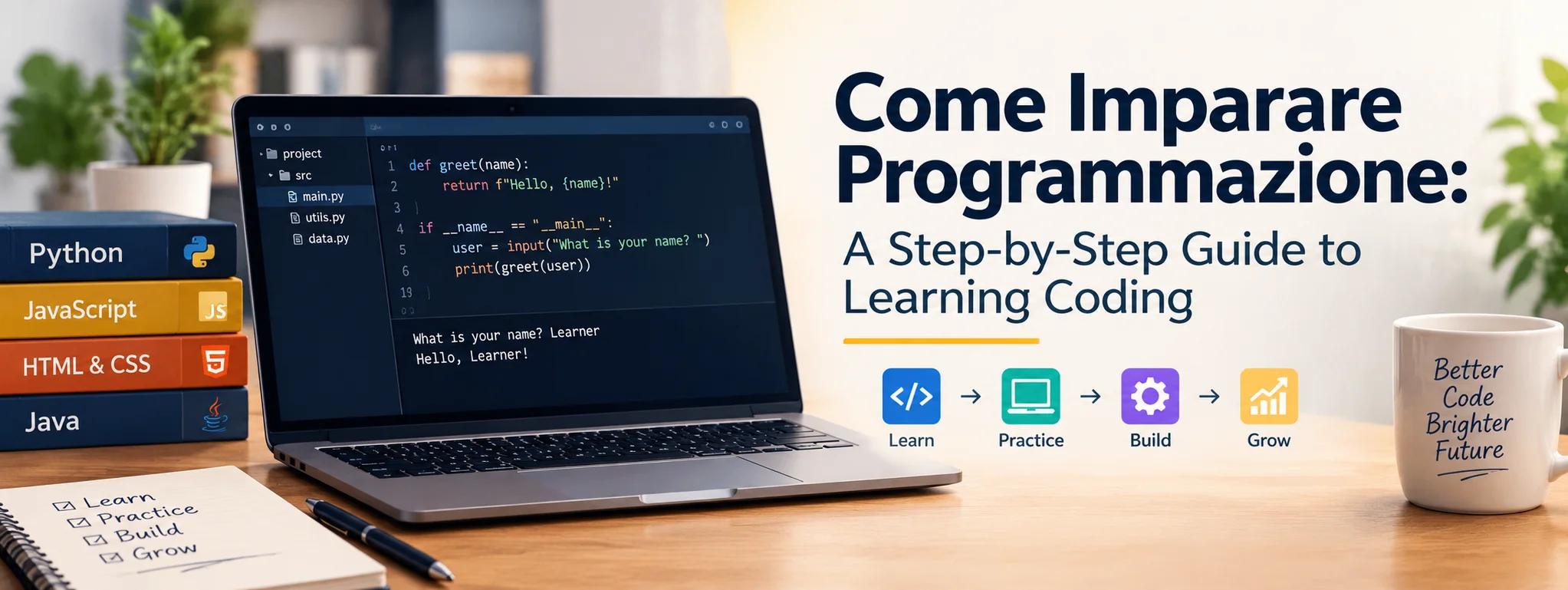
Learning to code can open exciting opportunities in technology, business, education, and creative problem-solving. If you are searching for Come Imparare Programmazione, the Italian phrase for “how to learn programming,” the good news is that you can begin without an advanced technical background. With the right learning strategy, consistent practice, and realistic goals, programming becomes easier to understand over time.
Programming allows you to give instructions to computers, build websites, automate repetitive tasks, and develop applications. Although the first steps may seem challenging, you do not need to learn every programming language at once. Instead, focus on fundamental concepts, choose a suitable language, and gradually build practical skills.
Come Imparare Programmazione: Start With the Basics
Before writing complicated code, understand what programming involves. A program is a set of instructions that tells a computer how to perform specific tasks. These instructions follow rules defined by a programming language.
Understand Fundamental Programming Concepts
Start by learning the concepts that appear in many programming languages.
- Variables: Store information such as names, numbers, and dates.
- Data types: Define the kinds of information a program can process.
- Conditions: Allow a program to make decisions based on specific rules.
- Loops: Repeat instructions without writing the same code repeatedly.
- Functions: Organize reusable instructions into manageable blocks.
These concepts form the foundation of programming. Once you understand them, learning another language or exploring a new technology becomes much easier.
Develop a Problem-Solving Mindset
Programming is not simply about memorizing commands. It involves breaking a large problem into smaller, manageable steps.
For example, if you want to create a calculator, begin by identifying the required operations, deciding how users will enter numbers, and determining how results will be displayed. This approach makes complex tasks less intimidating and helps you develop logical thinking.
Choose the Right Programming Language
Selecting your first programming language can influence your learning experience. However, there is no single language that suits everyone. Your choice should depend on your interests and long-term goals.
Python for Beginners
Python has a readable syntax and is widely used for automation, data analysis, artificial intelligence, and general software development. Beginners often find it approachable because many instructions resemble ordinary written language.
It is a strong starting point if you want to understand programming fundamentals before moving into more specialized areas.
HTML, CSS, and JavaScript for Websites
If your goal is to create websites, begin with HTML and CSS before learning JavaScript.
HTML structures a webpages, CSS controls its appearance, and JavaScript adds interactive features. Together, these technologies provide a practical foundation for front-end web development.
Java or C# for Software Development
Java and C# are useful options for learners interested in larger applications, enterprise software, and structured programming. Both support object-oriented programming and provide opportunities to explore more advanced development practices.
| Learning goal | Recommended starting technology | Example project |
| General programming | Python | Number guessing game |
| Website development | HTML, CSS, JavaScript | Personal website |
| Data analysis | Python | Simple data report |
| Enterprise applications | Java or C# | Task management tool |
| Interactive web applications | JavaScript | Interactive quiz |
Choose one starting path and give yourself enough time to understand it before switching to another language.
Follow a Step-by-Step Programming Learning Plan
A structured plan helps transform an ambitious goal into manageable daily activities.
Step 1: Set a Clear Goal
Decide what you want to create. You might want to develop websites, build mobile applications, automate office tasks, or explore data science.
A specific goal makes it easier to select learning materials and measure your progress. Instead of saying, “I want to learn everything about coding,” aim to build a simple working application within a month.
Step 2: Use Beginner-Friendly Resources
Start with official documentation, interactive coding exercises, video tutorials, and structured beginner courses. Choose resources that explain concepts clearly and include practical examples.
Avoid collecting too many courses at once. One well-organized learning resource, supported by regular practice, is usually more effective than jumping between multiple tutorials.
Step 3: Write Code Every Day
Consistency is more important than occasional long study sessions. Even 30 to 60 minutes of focused practice can help you develop familiarity with programming concepts.
Type the examples yourself rather than merely watching someone else write code. Experiment with changing values, modifying instructions, and observing how the output changes.
Step 4: Build Small Projects
Projects connect theory with real-world problem-solving. Start with manageable ideas and gradually increase their complexity.
Examples include a calculator, a to-do list, a personal portfolio, a temperature converter, or a simple budgeting tool.
Each completed project provides evidence of your progress and helps strengthen your confidence.
Step 5: Learn to Debug Errors
Errors are a normal part of programming. A syntax mistake, incorrect variable, or unexpected input can prevent a program from working correctly.
Read error messages carefully, isolate the problem, and test one change at a time. Learning to debug independently is an essential skill that becomes more valuable as projects grow.
Essential Tools for Learning Coding
You do not need an expensive computer or complicated setup to begin programming. Many beginner-friendly tools are available at little or no cost.
Choose a Code Editor
Editors such as Visual Studio Code can help you write, organize, and inspect code. Depending on your language, you may also need to install a runtime or compiler.
Alternatively, browser-based coding environments let you experiment without configuring a complete development setup.
Use Version Control
As your projects become more complex, consider learning Git. It records changes to your files and allows you to return to earlier versions when something goes wrong.
A code repository can also serve as a portfolio that demonstrates your work to potential employers or clients.
Common Challenges and How to Overcome Them
New programmers sometimes feel discouraged when tutorials become difficult or their code produces unexpected results. These experiences are normal and do not mean you lack the ability to learn.
- Avoid tutorial overload: Complete small projects instead of endlessly watching lessons.
- Break down difficult tasks: Solve one problem at a time.
- Practice consistently: Build a manageable daily routine.
- Ask specific questions: Share error messages and explain what you expected the program to do.
- Track your progress: Save completed projects and revisit earlier exercises to measure improvement.
Remember that progress is rarely perfectly linear. Some concepts become clear immediately, while others require repeated practice.
Final Thoughts
Learning programming is a rewarding journey that can develop your technical abilities, creativity, and confidence. The best approach to Come Imparare Programmazione is to establish clear goals, select one suitable language, master the fundamentals, and apply your knowledge through practical projects.
You do not need to become an expert overnight. Begin with small steps, learn from errors, and gradually tackle more challenging tasks. With patience and consistent effort, you can develop valuable coding skills and create projects that demonstrate what you have learned.
Frequently Asked Questions
1. What does Come Imparare Programmazione mean?
It is Italian for “how to learn programming.”
2. Which programming language is best for beginners?
Python is a popular starting point because its syntax is relatively readable. JavaScript is useful for aspiring web developers.
3. Can I learn programming without a degree?
Yes. You can learn through courses, documentation, practical exercises, and independent projects.
4. How long does it take to learn coding?
Basic concepts may take weeks to understand, while developing job-ready skills often requires months or longer, depending on practice and goals.
5. Can I learn programming for free?
Yes. Free documentation, tutorials, online coding environments, and practice platforms provide many opportunities to get started.
One Reply to “Come Imparare Programmazione: A Step-by-Step Guide to Learning Coding”