
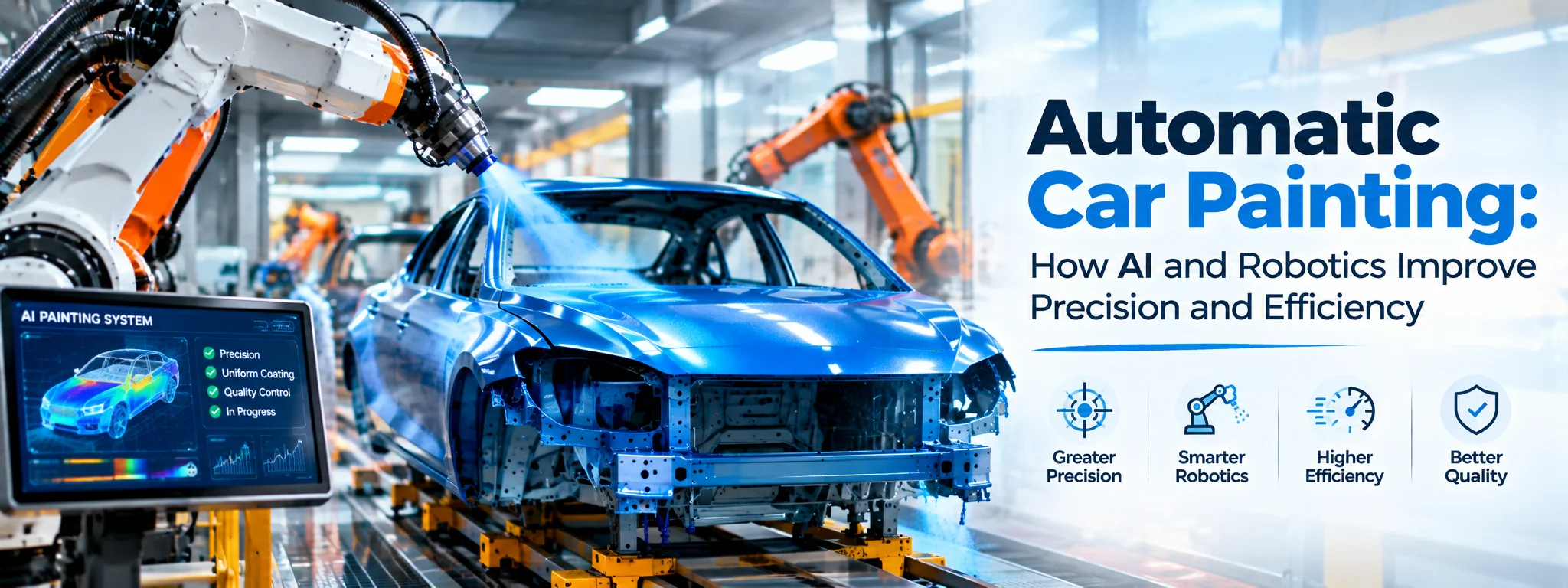
Automatic Car Painting is transforming the automotive manufacturing industry by combining robotics, artificial intelligence (AI), and advanced coating technologies. Traditional vehicle painting often depends on skilled workers to apply paint evenly across complex surfaces. Although manual methods remain useful for certain tasks, automated systems deliver greater consistency, reduce material waste, and improve production efficiency.
Modern automotive factories use robotic arms, 3D machine vision, and AI-driven path planning to paint vehicle bodies with remarkable precision. These technologies help manufacturers achieve smooth finishes, consistent colors, and durable coatings while maintaining high production standards. Understanding how automatic car painting works reveals why it has become an essential part of modern vehicle manufacturing.
What Is Automatic Car Painting?
Automatic car painting is a manufacturing process that uses programmed equipment and robotic systems to apply paint to vehicle surfaces. These systems control the movement of spray guns, paint flow, application speed, and spraying distance.
Unlike traditional manual painting, automated equipment follows carefully calculated paths to cover complex vehicle shapes. The result is a more uniform finish with fewer inconsistencies.
Key Technologies Behind Automated Painting
Several advanced technologies work together to improve the painting process:
- Robotic arms: Move spray guns smoothly around vehicle panels.
- Artificial intelligence: Helps optimize spraying patterns and application settings.
- 3D machine vision: Detects vehicle shapes, dimensions, and surface positions.
- AI-driven path planning: Calculates efficient spray routes around curves and edges.
- Automated sensors: Monitor operating conditions and support consistent coating quality.
Together, these technologies create a controlled painting environment that supports reliable, high-quality production.
How AI and Robotics Improve Painting Precision
Precision is one of the greatest advantages of automatic car painting. A vehicle contains surfaces with different angles, curves, and depths, making uniform paint application challenging. Robotic systems address these challenges through accurate movement and intelligent control.
Robotic Arms for Consistent Coverage
Robotic arms follow programmed trajectories to maintain suitable spraying distances, angles, and speeds. This consistency helps reduce uneven layers, visible streaks, and excessive paint buildup.
Robots can also repeat the same movements across thousands of vehicles. Manufacturers benefit from predictable results without depending entirely on individual spraying techniques.
3D Machine Vision and Surface Detection
3D machine vision systems use cameras and sensors to identify vehicle geometry. They can help determine panel positions and detect changes in surface shape.
This information allows painting equipment to adjust its movements to match the vehicle body. Better surface detection improves coverage around doors, bumpers, mirrors, and other complicated areas.
Intelligent Spray Path Planning
AI-driven path planning helps determine the most effective route for spray guns. Depending on the system, software can consider surface geometry, paint requirements, robot movement, and production constraints.
Optimized paths reduce unnecessary movements and help ensure that paint reaches the intended areas. This creates opportunities for faster production and more consistent finishes.
Benefits of Automatic Car Painting
Automated painting offers several advantages for vehicle manufacturers. Its value comes from improving quality while controlling production costs.
Greater Efficiency and Reduced Waste
Robots can operate continuously within properly designed production lines, reducing delays between painting stages. Precise spray control can also limit over spray, which occurs when paint misses the intended surface.
Lower material waste can reduce costs and support more responsible manufacturing practices.
Improved Finish and Durability
Consistent paint application helps create an attractive surface with uniform color and texture. When combined with appropriate surface preparation, curing, and quality inspection, automated painting can support durable coatings that resist ordinary environmental exposure.
Better Workplace Safety
Automotive paints may contain hazardous chemicals and generate airborne particles. Automated systems can reduce workers’ direct exposure by performing spraying inside controlled, ventilated enclosures.
Human supervision and appropriate safety procedures remain essential for maintenance, inspection, and equipment operation.
Automatic Car Painting Compared With Manual Painting
| Feature | Automatic Car Painting | Manual Car Painting |
|---|---|---|
| Precision | Highly repeatable movements | Depends on operator skill |
| Production speed | Suitable for high-volume lines | Often slower for large-scale production |
| Paint consistency | Consistent when correctly calibrated | Can vary between applications |
| Material efficiency | Can reduce over spray | Depends on technique and equipment |
| Initial investment | Generally high | Usually lower |
| Flexibility | Requires programming and setup | Useful for custom, small-scale jobs |
The best method depends on production volume, vehicle design, budget, and finishing requirements. Automated systems are particularly valuable for large manufacturing facilities, while manual painting can remain practical for repairs and specialized projects.
Challenges in Automated Automotive Painting
Despite its advantages, automatic car painting requires careful planning and investment.
High Equipment Costs
Robotic arms, vision systems, spray equipment, ventilation, and control software can require substantial upfront spending. Manufacturers must evaluate whether expected productivity improvements justify the investment.
Maintenance and Skilled Operators
Automated equipment needs regular inspection, cleaning, calibration, and maintenance. Skilled technicians are necessary to troubleshoot faults and maintain reliable performance.
Environmental Considerations
Paint emissions, energy consumption, and coating waste remain important concerns. Manufacturers can improve sustainability by selecting suitable low-emission coatings, optimizing spray transfer efficiency, and using energy-efficient curing systems.
Future Trends in Automatic Car Painting
The future of automatic car painting will likely involve smarter inspection, more adaptive robotics, and improved environmental performance.
Machine learning can help analyze production data and identify recurring defects. Connected sensors may support predictive maintenance by detecting performance changes before equipment fails.
Manufacturers are also exploring more efficient coating materials and processes that reduce energy consumption and environmental impact. As these technologies mature, automated painting systems may become more adaptable to different vehicle models and changing production demands.
Final Thoughts
Automatic Car Painting is a powerful example of how AI and robotics are improving modern manufacturing. Robotic arms deliver repeatable movements, 3D machine vision helps identify complex surfaces, and intelligent path planning improves spray coverage and production efficiency.
Although high installation costs and ongoing maintenance remain challenges, automation can provide significant advantages in consistency, material use, productivity, and worker safety. As artificial intelligence and sensor technology continue to advance, automated automotive painting will play an increasingly important role in producing attractive, reliable, and durable vehicle finishes.
FAQs
1. What is automatic car painting?
It is a process that uses robotic equipment and automated controls to apply paint to vehicle surfaces.
2. How does AI improve car painting?
AI can help optimize spray paths, analyze production data, and improve process consistency.
3. What is the role of 3D machine vision?
It detects vehicle shapes and surface positions, helping robots adjust their movements for accurate coverage.
4. Does automatic car painting reduce paint waste?
Yes, well-calibrated systems can reduce over spray and improve paint transfer efficiency.
5. Is automatic car painting better than manual painting?
It is generally advantageous for high-volume production, while manual painting remains useful for repairs and specialized jobs.
One Reply to “Automatic Car Painting: How AI and Robotics Improve Precision and Efficiency”