
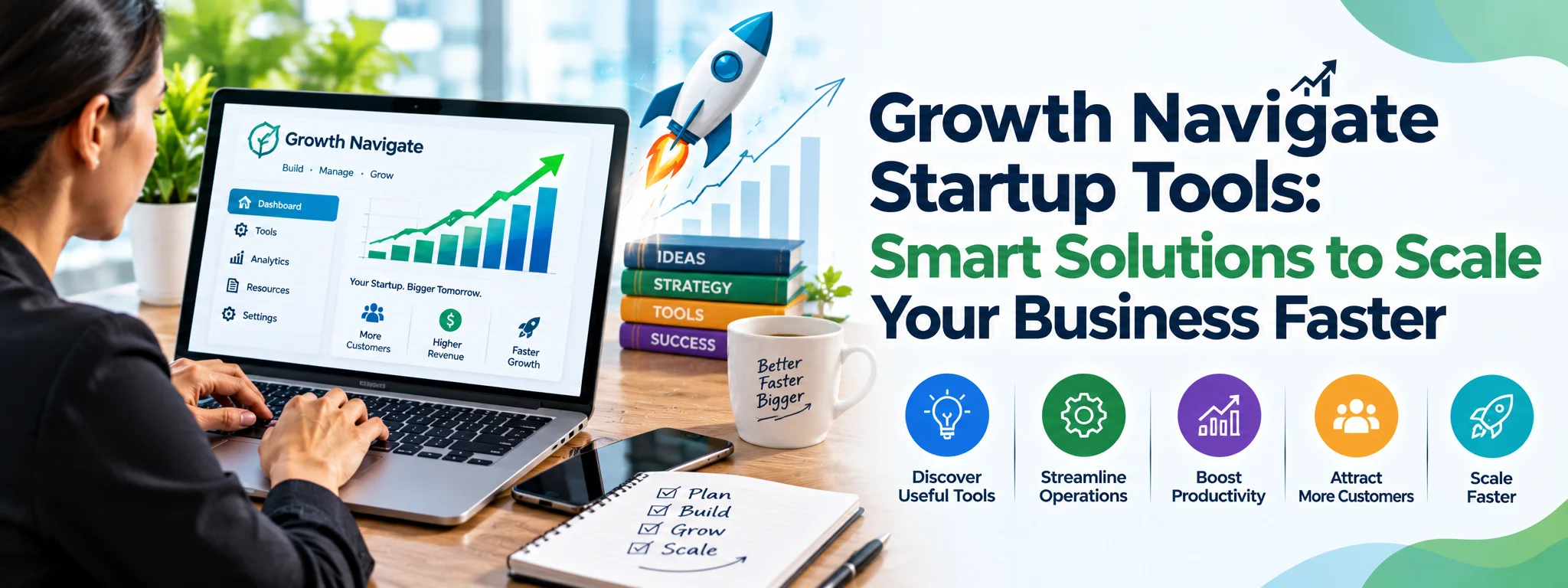
Building a successful startup requires more than a great idea. Entrepreneurs must manage finances, attract customers, organist daily operations, and make smart decisions while working with limited resources. This is where growth navigate startup tools become valuable, helping businesses simplify complicated tasks, improve productivity, and create a stronger foundation for sustainable growth.
From project management platforms and customer relationship management systems to marketing automation and financial analytics, the right tools can make everyday business activities easier. They help founders save time, reduce unnecessary expenses, understand customer behavior, and identify new opportunities before competitors do.
However, choosing software without a clear strategy can create confusion rather than progress. Startups need practical solutions that match their current goals, budget, team size, and future ambitions.
What Are Growth Navigate Startup Tools?
Growth navigate startup tools refer to digital platforms, software applications, and business resources that help new companies manage operations, improve performance, and expand their market presence.
The phrase describes a practical approach to startup growth rather than one specific software product. These tools can support almost every part of a business, including marketing, sales, accounting, customer service, communication, and strategic planning.
For example, a small online business might use a project management platform to organist tasks, a customer relationship management system to track potential buyers, and analytics software to measure website performance.
When these systems work together, founders gain a clearer picture of their business and can make more informed decisions.
Why Startups Need Smart Digital Tools
Early-stage companies often operate with small teams and limited budgets. Employees may handle several responsibilities simultaneously, making manual processes difficult to maintain as demand increases.
Digital tools help address these challenges by introducing structure and automation.
They can reduce repetitive work, improve communication, organist customer information, and reveal opportunities for improvement. Instead of spending hours updating spreadsheets or searching through messages, teams can focus on activities that generate revenue and strengthen customer relationships.
The real advantage comes from selecting tools that solve specific problems rather than adopting every new platform available.
How Growth Navigate Startup Tools Help Businesses Scale
Growth requires a combination of efficient operations, reliable customer relationships, financial discipline, and consistent marketing. The right software can support these areas while helping a startup prepare for increasing demand.
1. Improve Productivity and Team Collaboration
Project management tools help founders assign responsibilities, establish deadlines, and monitor progress from one central workspace.
Platforms such as Trellis, Astana, and ClickUp provide different ways to organist projects, track tasks, and coordinate teams.
A startup launching a new product, for example, can create separate tasks for product development, website updates, advertising, and customer support. Team members can see their responsibilities without relying on constant meetings.
This improves accountability and reduces the risk of missed deadlines.
2. Strengthen Customer Relationships
Customer relationship management (CM) software helps businesses organist leads, maintain customer records, and monitor sales conversations.
Tools such as HubSpot CM and Zoo CM can help startups understand where potential customers are in the buying process.
A founder can identify which prospects need follow-up, which customers have already purchased, and which opportunities are most likely to produce revenue.
Better customer organization also supports personalized communication, helping businesses build trust and encourage repeat purchases.
3. Automate Repetitive Business Tasks
Automation can save valuable time when startups begin handling larger volumes of work.
For example, businesses can automate email confirmations, lead notifications, appointment reminders, and certain reporting activities.
Platforms such as Zanier and Make connect compatible applications and allow information to move between systems according to predefined rules.
However, automation should be introduced carefully. Important customer communications, financial decisions, and sensitive processes may still require human review.
The goal is to remove unnecessary repetition while preserving accuracy and personal attention.
Essential Growth Navigate Startup Tools for Different Business Needs
Not every startup requires the same technology. An online store, software company, marketing agency, and local service business will have different operational priorities.
The following categories provide a useful starting point.
Business Tools and Their Main Benefits
| Tool category | Example platforms | Primary benefit |
|---|---|---|
| Project management | Trellis, Astana | Organists tasks and deadlines |
| Customer management | HubSpot CM, Zoo CM | Tracks leads and customer relationships |
| Marketing automation | Mail chimp, Breve | Supports email campaigns |
| Website analytics | Google Analytics | Measures website activity |
| Financial management | QuickBooks, Xerox | Organists accounting and reporting |
| Team communication | Slack, Microsoft Teams | Improves internal communication |
| Automation | Zanier, Make | Connects applications and repetitive workflows |
| Design and content | Canvas | Helps create marketing materials |
These examples represent different software categories, not a requirement to purchase every platform. Availability, features, and pricing may vary by plan and location.
4. Make Better Decisions With Business Analytics
Data analytics helps founders understand what is happening across their businesses.
Website analytics can reveal where visitors come from, which pages receive attention, and where potential customers leave a website. Sales reports can identify popular products, while financial reports help owners monitor expenses and revenue.
These insights make it easier to distinguish genuine growth from temporary activity.
For instance, an online store might attract thousands of visitors but generate very few orders. Analytics can help identify whether the problem relates to product pages, pricing, checkout usability, or the quality of incoming traffic.
A small number of meaningful measurements is often more valuable than a dashboard filled with irrelevant statistics.
5. Build a Stronger Marketing Strategy
Marketing tools help startups reach potential customers through search engines, email campaigns, social media, and paid advertising.
SEO platforms can support keyword research and content optimization. Email marketing software can organist subscribers and deliver relevant messages. Design applications help businesses produce consistent promotional materials.
The strongest approach combines these capabilities with a clear understanding of the target audience.
Rather than publishing content everywhere, a startup should identify the channels its customers actually use and focus its resources accordingly.
Consistent marketing can gradually improve brand recognition, attract qualified leads, and create opportunities for long-term growth.
How to Choose the Right Startup Tools
Selecting software should begin with business needs, not popularity. An application that works well for a large company may be unnecessarily complicated for a team of three people.
Identify Your Biggest Business Challenges
Start by reviewing the activities that consume the most time or create recurring problems.
These might include missed sales follow-ups, disorganized project schedules, inconsistent marketing, unclear financial records, or slow customer responses.
Choose a tool that directly addresses one of these challenges. Establishing a clear purpose makes it easier to evaluate whether the software is producing meaningful results.
Compare Cost, Features, and Scalability
Free software can be an excellent starting point, but its limitations may become noticeable as the business expands.
Before committing to a subscription, review user limits, automation allowances, integration, reporting features, support options, and data-export capabilities.
A low monthly price is not always the most economical option if the software requires extensive manual work or expensive additional services.
The best solution offers enough functionality for current needs without creating unnecessary complexity.
Important Factors When Comparing Startup Tools
| Evaluation factor | Questions to consider |
|---|---|
| Affordability | Does the cost fit the current budget? |
| Ease of use | Can the team learn it quickly? |
| Integration | Does it connect with existing systems? |
| Security | Are appropriate access controls and safeguards available? |
| Scalability | Can it support additional customers and employees? |
| Reporting | Does it provide useful performance insights? |
| Support | Is reliable documentation or assistance available? |
Review these factors before migrating important business information or signing a long-term agreement.
Common Mistakes Startups Should Avoid
Technology can improve business performance, but poor implementation may waste money and create unnecessary work.
One frequent mistake is adopting too many applications simultaneously. Multiple platforms can introduce overlapping subscriptions, scattered information, and inconsistent processes.
Another mistake is automating a workflow before understanding it. If a process is inefficient, automation may simply make the same problem happen faster.
Startups should also avoid measuring success through vanity metrics alone. Website visits, social media followers, and email opens can be useful indicators, but they do not automatically translate into revenue or customer loyalty.
To get better results, focus on practical improvements:
- Set clear objectives: Define the problem each tool must solve.
- Start small: Test a limited set of applications before expanding.
- Train your team: Make sure employees understand the essential features.
- Monitor performance: Compare results against meaningful business targets.
- Review subscriptions: Remove tools that provide little measurable value.
These steps help startups control costs, reduce confusion, and build a more efficient technology setup.
A Practical Road map for Implementing Startup Tools
Introducing new software works best when it follows a structured process. A simple implementation plan reduces disruption and helps teams understand whether a new solution is worth keeping.
Phase One: Organist the Essentials
Begin with the systems your business needs to operate reliably. These may include accounting software, task management, secure file storage, and a central place to manage customer information.
Avoid complex automation during this stage. Establish consistent processes first so the team has a reliable foundation.
Phase Two: Improve Customer Acquisition
Once the basics are organized, introduce tools that support marketing, sales, and customer engagement.
Track lead sources, monitor website performance, and measure how effectively marketing campaigns generate qualified inquiries.
Use these results to identify the channels that deserve more investment.
Phase Three: Automate and Optimist
After your core workflows become consistent, look for repetitive tasks that can be automated safely.
Connect compatible systems, create useful reports, and review performance regularly. Remove unnecessary steps whenever possible.
This gradual approach allows the company to grow without making its operations unnecessarily complicated.
The Future of Startup Growth Technology
Startup technology continues to evolve, with artificial intelligence, predictive analytics, and workflow automation becoming increasingly accessible.
AI-powered tools can assist with drafting marketing content, summarizing customer feedback, analyzing information, and supporting research. Predictive analytics can help businesses examine historical patterns and estimate future demand.
However, these capabilities require sensible oversight. AI-generated information may contain errors, and automated systems can expose confidential information if configured poorly.
Startups should establish clear data-handling practices, review important outputs, and retain human responsibility for significant decisions.
The most effective technology strategy combines innovation with sound judgment. Tools should strengthen the team’s abilities rather than replace thoughtful planning or genuine customer relationships.
Final Thoughts
Growth navigate startup tools provide a useful framework for understanding how technology can help entrepreneurs build, organist, and expand their businesses. From project management and customer relationship systems to analytics, marketing automation, and financial software, the right solutions can reduce repetitive work and reveal valuable opportunities.
Success does not depend on using the largest number of applications. It depends on selecting reliable tools that address real challenges, fit the budget, and support measurable objectives.
Frequently Asked Questions
1. What are growth navigate startup tools?
Growth navigate startup tools are digital applications and resources that help startups manage operations, improve productivity, attract customers, and support business expansion.
2. Which tools should a new startup use first?
Most startups should begin with essential tools for accounting, project management, customer organization, communication, and website analytics.
3. Can startup tools help a business grow faster?
Yes. Suitable tools can reduce repetitive tasks, improve customer follow-ups, strengthen marketing decisions, and help teams use their resources more efficiently.
4. Are free startup tools enough for a small business?
Free plans may be sufficient for early-stage businesses. Paid features become useful when a company needs additional users, automation, integration, or advanced reporting.
5. How many startup tools should a business use?
There is no fixed number. Start with a small collection that covers essential business needs, then add applications when a clear operational benefit justifies the cost.
One Reply to “Growth Navigate Startup Tools: Smart Solutions to Scale Your Business Faster”