
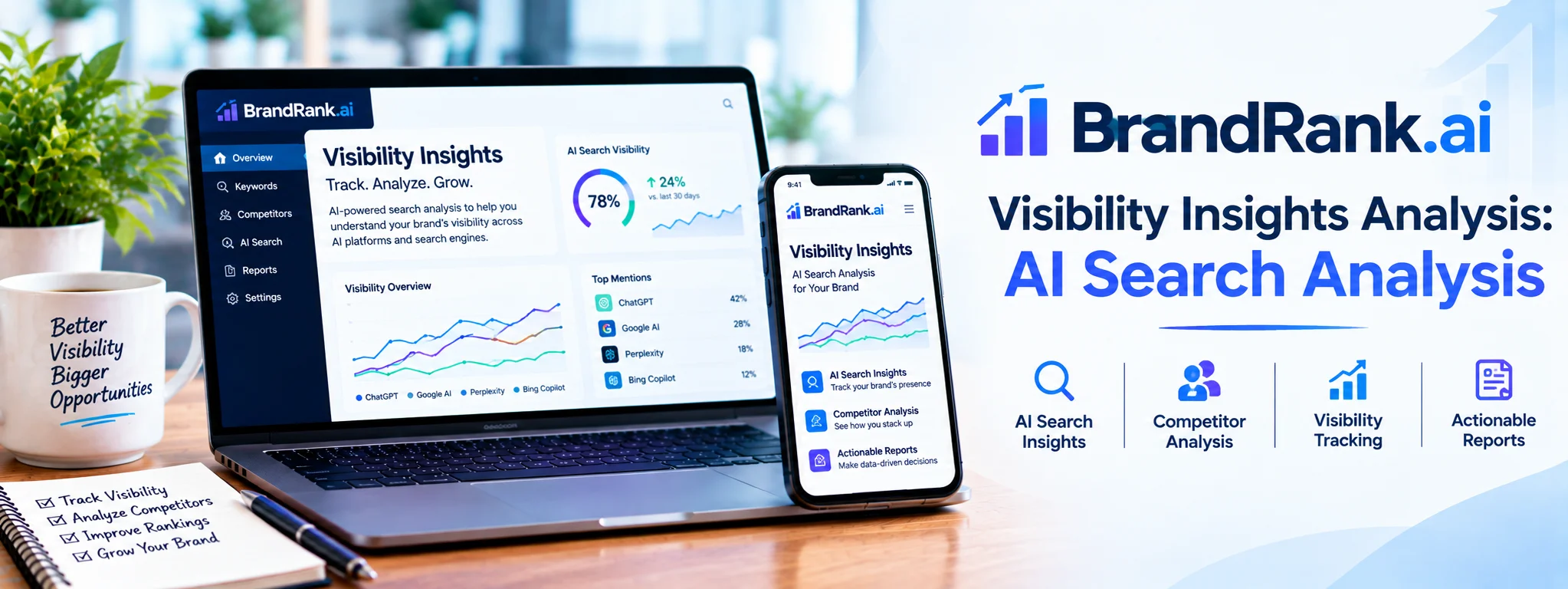
As AI-powered search continues to change how people find information online, BrandRank.ai Visibility Insights Analysis offers a useful way to understand how brands may appear across modern AI search experiences. Traditional SEO focuses heavily on rankings, keywords, back links, and organic traffic. AI search analysis adds another layer by examining how brands, products, websites, and topics are represented in AI-generated answers.
For businesses, publishers, and marketers, visibility is no longer limited to appearing on a conventional search results page. A brand can gain attention when an AI system references, summarizes, or recommends information from its digital presence. Understanding these patterns can help organizations create clearer content, strengthen authority, and identify opportunities that traditional SEO reporting may overlook.
Why AI Search Visibility Matters
AI search changes the way users interact with online information. Instead of browsing several pages, users can receive a summarized response containing explanations, comparisons, recommendations, and direct answers.
This creates a new visibility challenge. A website may rank well for a traditional keyword but receive limited exposure in AI-generated responses. Another source with highly structured, trustworthy, and relevant information may become more prominent in an AI answer.
From Rankings to Mentions
Traditional SEO often asks, “Where does this page rank?” AI search analysis asks broader questions:
- Is the brand mentioned in AI-generated answers?
- Which topics are associated with the brand?
- How frequently does the brand appear across relevant questions?
- Which competitors receive stronger AI visibility?
- What type of content appears to support those mentions?
These insights can reveal a different side of search performance.
BrandRank.ai Visibility Insights Analysis for Modern SEO
BrandRank.ai Visibility Insights Analysis can be viewed as a framework for studying brand presence within AI-driven search environments. The goal is not simply to track conventional positions but to understand how a brand is represented when users ask natural-language questions.
AI visibility can depend on several factors, including content quality, topical relevance, authority signals, factual clarity, and the availability of information across the web.
Key Areas to Examine
A practical analysis can focus on:
| Area | What to Examine | Potential Insight |
|---|---|---|
| Brand mentions | Frequency and context | Overall AI presence |
| Topics | Questions linked to the brand | Content opportunities |
| Competitors | Other referenced sources | Competitive gaps |
| Sources | Pages supporting responses | Authority patterns |
| Sentiment | Positive, neutral, or negative context | Brand perception |
| Coverage | Different questions and subjects | Visibility breadth |
These areas provide a more complete picture than a single ranking position.
Building Content for AI Search
Creating content for AI search does not mean abandoning traditional SEO. Instead, businesses can combine established optimization practices with content designed to provide direct, reliable information.
Clear writing is particularly important. Pages should answer meaningful questions without unnecessary repetition. Strong headings, concise explanations, useful examples, factual statements, and logical organization can make information easier for both readers and automated systems to interpret.
Strengthen Topical Authority
A website should demonstrate meaningful knowledge across a focused subject rather than publishing disconnected articles simply to target keywords.
For example, a company covering digital marketing could develop related resources about:
- Search optimization fundamentals
- AI search visibility
- Content structure
- Brand mentions
- Search intent
- Authority signals
A connected content ecosystem can create stronger topical relevance and give users a more useful experience.
Important Metrics for AI Visibility
AI search analysis works best when several signals are considered together. Depending on the platform and available data, useful measurements may include mention frequency, citation frequency, query coverage, competitor presence, and content representation.
Track Changes Over Time
AI search results can change as systems evolve, information is updated, and new sources become available. A single observation may therefore provide only a limited snapshot.
Regular monitoring can help identify meaningful trends. A brand that appears for a growing range of relevant questions may be expanding its digital footprint, while declining mentions could indicate new competitive pressure or content gaps.
Five Practical Ways to Improve Visibility
Businesses can use AI search insights to guide practical improvements rather than making changes based on assumptions.
- Create direct answers: Address important customer questions clearly and naturally.
- Improve factual clarity: Keep important claims accurate, specific, and easy to verify.
- Build topic clusters: Connect related pages around important subjects.
- Study competitor coverage: Identify topics where competing brands receive attention.
- Refresh valuable content: Update outdated information and strengthen weak sections.
These actions can support both traditional search performance and emerging AI discovery channels.
The Role of Brand Reputation
AI visibility is not only about technical optimization. The wider digital reputation of a brand can also matter. Businesses should maintain consistent information across important online properties and ensure that descriptions of their products, services, and expertise are accurate.
A strong digital footprint gives users more reliable information to evaluate. It can also create a broader collection of relevant references around a brand.
Avoid Chasing Every AI Mention
Not every mention has equal value. Businesses should focus on relevant questions and audiences rather than trying to appear in every possible AI response.
Quality, relevance, and accuracy should remain central. A focused visibility strategy can be more meaningful than generating large amounts of content without a clear purpose.
Challenges in AI Search Analysis
AI search introduces several uncertainties. Different systems can produce different answers for similar questions. Results may also change because models, indexes, retrieval systems, and source selections are continuously evolving.
This means AI visibility should not be treated as a permanent ranking. Instead, it is better understood as a changing performance signal.
Another challenge is attribution. An AI-generated response may summarize information from multiple sources, making it harder to determine exactly why a particular brand was mentioned. This is why AI analysis should be combined with traditional analytics, content reviews, and broader SEO research.
Future Opportunities for Brands
The growth of conversational search creates an exciting opportunity for organizations that publish genuinely useful information. Brands can move beyond keyword-focused publishing and develop resources that answer real questions in a detailed yet accessible way.
As AI search becomes more integrated into everyday research, visibility may increasingly depend on whether a brand has clear expertise and useful information available across the web. This makes content quality, trust, consistency, and topical depth increasingly valuable.
Final Thoughts
BrandRank.ai Visibility Insights Analysis highlights an important shift in digital marketing: search visibility is expanding beyond traditional blue-link rankings. AI-generated answers can introduce brands to users through mentions, summaries, comparisons, and references.
For businesses seeking sustainable visibility, the strongest approach is to create accurate, useful, well-structured content while monitoring how their brand appears across relevant AI search experiences. Combining AI search analysis with traditional SEO data can provide a broader perspective and reveal valuable opportunities for future growth.
FAQs
1. What is AI search analysis?
It examines how brands and content appear within AI-powered search responses.
2. Why is AI visibility important?
It can influence how users discover and evaluate brands through conversational search.
3. Can AI visibility replace traditional SEO?
No. AI visibility and traditional SEO provide different but complementary insights.
4. How can brands improve AI visibility?
Publish accurate, useful, well-organized content that addresses relevant user questions.
5. Should AI visibility be monitored regularly?
Yes. AI responses can change over time, so ongoing analysis can reveal emerging patterns.