
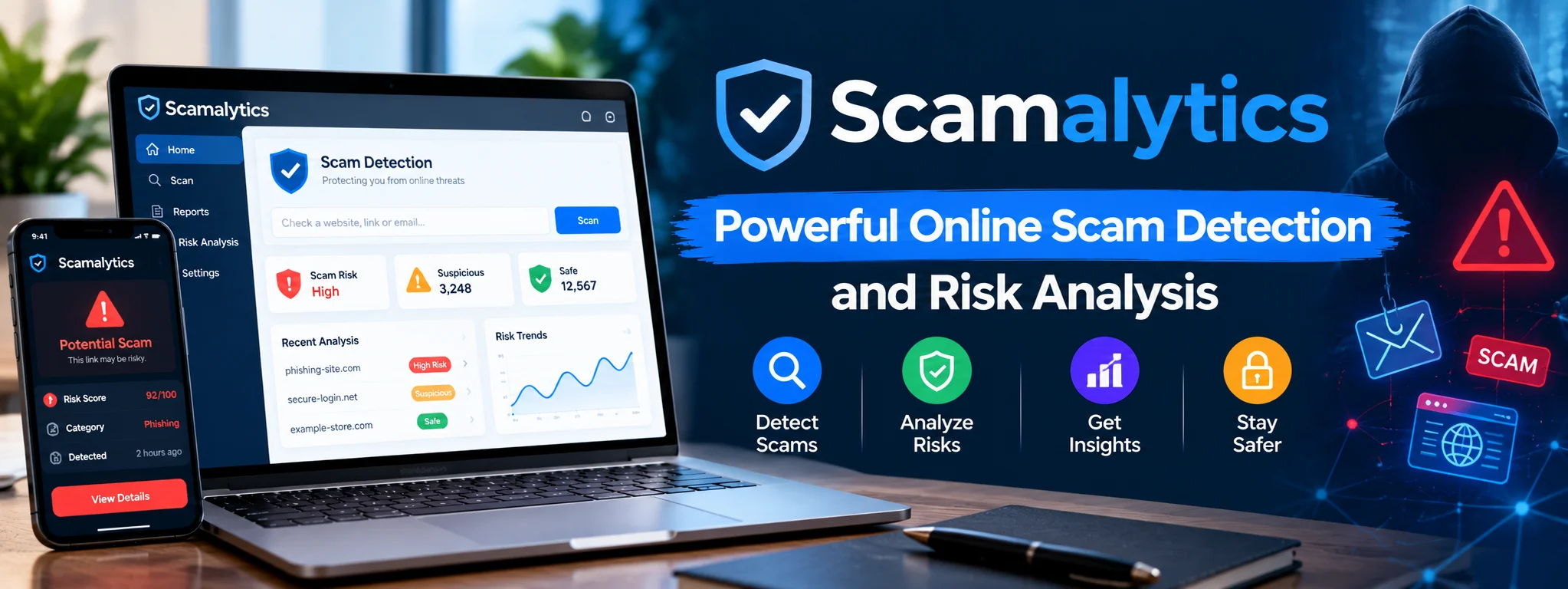
Online fraud has become an increasingly serious challenge for businesses, websites, financial services, and everyday internet users. Suspicious visitors, automated attacks, fake accounts, payment abuse, and other forms of malicious activity can create significant security and financial risks. Scamalytics is a technology platform designed to help organizations identify potentially fraudulent internet traffic through IP intelligence, fraud detection, and risk analysis.
The platform focuses on analyzing online activity and assigning risk indicators that can help businesses make better decisions about visitors and transactions. Instead of relying on a single signal, Scamalytics can evaluate multiple characteristics associated with an IP address and its online behavior.
What Is Scamalytics?
Scamalytics is an online fraud-detection and IP intelligence service that helps businesses assess whether internet traffic may be associated with fraudulent or suspicious activity.
Its technology is particularly relevant to organizations that need to evaluate visitors before allowing them to register, log in, purchase products, access promotions, or complete other online activities.
The platform can provide information that helps distinguish between potentially legitimate users and higher-risk traffic. This type of analysis is useful because an IP address can reveal characteristics about the network or environment from which a connection originates.
How Scamalytics Supports Risk Analysis
Fraud detection is rarely based on one simple indicator. A sophisticated system can consider different signals before generating a risk assessment.
Scamalytics is designed around this broader approach. Its analysis can help businesses identify traffic that may have characteristics associated with:
- Proxies and VAN connections
- Hosting or data-center networks
- Automated traffic
- Suspicious IP addresses
- Fraud-related activity
- Anonymous or masked connections
The purpose is not simply to label every unusual visitor as fraudulent. Instead, risk intelligence can give organizations additional information that supports smarter decisions.
Why Online Scam Detection Matters
Digital businesses face a constantly changing threat landscape. Fraudsters can use compromised accounts, automated tools, proxy networks, stolen payment information, and manipulated identities to bypass traditional security controls.
A business that ignores suspicious activity may experience financial losses, account abuse, charge backs, reputation damage, or operational disruption.
Protecting Digital Businesses
Consider an online marketplace where thousands of users create accounts every day. Some visitors may be genuine customers, while others could be attempting to create multiple accounts for abuse or manipulate promotions.
An IP intelligence platform can provide another layer of information.
The same principle applies to financial websites, gaming platforms, commerce stores, advertising networks, and subscription services. Each organization has different risk requirements, but the underlying objective is similar: identify suspicious activity before it becomes a costly problem.
Key Features Associated With Scamalytics
Scamalytics is primarily associated with IP-based fraud intelligence and risk assessment. Its usefulness comes from combining technical information with fraud-related signals.
IP Risk Assessment
One of the central concepts is IP risk scoring. A score or classification can help a business understand whether an IP address appears relatively trustworthy or potentially problematic.
Risk scoring can be useful as part of an automated workflow. For example, a website could allow low-risk visitors to continue normally while sending higher-risk activity for additional verification.
Proxy and VAN Detection
Privacy tools such as Vans and proxies have many legitimate uses. However, they can also make it more difficult for businesses to determine where traffic originates.
Scamalytics can help identify connections associated with proxy or VAN infrastructure. This information can be particularly valuable for businesses where location and identity signals matter.
Importantly, using a VAN does not automatically mean that a visitor is fraudulent. A risk engine should therefore be treated as a decision-support tool rather than an unquestionable verdict.
Data-Center Traffic Identification
Traffic originating from hosting providers or data centers can sometimes have a different risk profile from ordinary residential connections.
Automated software, bots, scraping tools, and other systems may operate from these environments. Identifying such connections can help businesses apply appropriate controls.
How Scamalytics Can Be Used by Businesses
Different industries can benefit from IP intelligence in different ways.
Commerce and Online Retail
Online stores regularly deal with payment fraud, account abuse, fake registrations, and suspicious orders.
Risk information can be incorporated into fraud-screening processes to identify transactions or visitors that deserve additional attention.
Online Gaming and Entertainment
Gaming websites can face account manipulation, promotional abuse, bots, and other forms of suspicious behavior.
Risk analysis can help platforms understand whether a connection appears unusual and determine whether additional checks are appropriate.
Advertising Platforms
Advertising fraud can waste marketing budgets by generating invalid clicks, automated impressions, or artificial engagement.
Traffic intelligence can help advertising businesses investigate unusual patterns and improve the quality of their traffic.
Scamalytics and Automated Fraud Prevention
Modern fraud detection increasingly depends on automation. Businesses cannot manually inspect every visitor or transaction, particularly when websites receive large volumes of traffic.
Automated risk assessment can help organizations process information quickly.
A simplified workflow might look like this:
| Stage | Purpose |
| Visitor connection | A user accesses a website or service |
| IP analysis | Network information is examined |
| Risk signals | Suspicious characteristics are identified |
| Risk assessment | The connection receives an indication of potential risk |
| Business decision | The organization allows, reviews, verifies, or restricts activity |
Benefits of Using IP Intelligence
A strong risk-analysis system can offer several practical advantages when integrated properly.
Faster Decision-Making
Automated analysis can evaluate connections much faster than manual investigation. This is particularly valuable for websites processing large numbers of visitors.
Better Fraud Visibility
Businesses can gain additional insight into traffic patterns that may otherwise appear normal.
Flexible Security Controls
Risk information can be combined with other signals, such as account behavior, transaction history, device information, and authentication results.
Reduced Exposure
Early identification of potentially risky activity can help businesses investigate suspicious behavior before it develops into a larger incident.
Important Limitations to Consider
No fraud-detection system should be considered perfect.
An IP address does not reveal a person’s complete identity, intentions, or behavior. Multiple legitimate users can share an IP address, while sophisticated attackers can manipulate their network environment.
Risk Scores Are Not Final Judgments
A high-risk indication should generally be considered a signal rather than definitive proof of fraud.
For example, a legitimate customer traveling abroad may use a VAN and suddenly appear different from their usual traffic pattern. Automatically blocking that person could create unnecessary frustration.
Businesses should therefore combine IP intelligence with additional evidence.
Privacy and Compliance
Organizations using fraud-detection technologies should also consider privacy obligations and applicable regulations.
Data should be handled responsibly, access should be limited where appropriate, and organizations should understand how their security tools process information.
Best Practices for Using Scamalytics
Businesses can obtain better results when IP intelligence is integrated into a broader security strategy.
Five useful practices include:
- Combine multiple signals: Do not rely exclusively on IP information when making important decisions.
- Use risk-based controls: Apply different levels of verification according to the potential risk.
- Review false positives: Legitimate users can sometimes trigger suspicious indicators.
- Monitor changing patterns: Fraud techniques evolve, so security rules should be regularly evaluated.
- Protect user privacy: Use collected information responsibly and follow applicable privacy requirements.
Who Can Benefit From Scamalytics?
Scamalytics can be particularly relevant to organizations that need to evaluate internet traffic before providing access to valuable services.
Potential users include commerce businesses, financial platforms, online marketplaces, advertising companies, gaming services, subscription platforms, and other digital organizations.
The value becomes greater when suspicious traffic can create measurable financial or security consequences.
A Layered Security Strategy
The strongest approach is rarely based on one product. IP intelligence works best as one component of a layered fraud-prevention strategy.
Other layers might include:
- Account authentication
- Device intelligence
- Behavioral analysis
- Payment verification
- Rate limiting
- Bot detection
- Manual investigation
Final Thoughts
Scamalytics provides a focused approach to online fraud detection through IP intelligence and risk analysis. By examining characteristics associated with internet connections, businesses can gain useful information when evaluating potentially suspicious traffic.
Its greatest value comes from supporting informed decisions rather than replacing human judgment or broader security controls. IP-based intelligence can identify valuable warning signals, but legitimate users may sometimes share characteristics with suspicious traffic.
FAQs
What does Scamalytics do?
Scamalytics provides IP intelligence and fraud-risk analysis to help businesses identify potentially suspicious internet traffic.
Can Scamalytics detect Vans?
Its technology is associated with identifying VAN and proxy connections, which can provide useful context during fraud screening.
Is every VAN user fraudulent?
No. Vans have many legitimate privacy and security uses. A VAN indicator should be treated as one risk signal rather than proof of fraud.
Who can use Scamalytics?
Commerce companies, financial services, gaming platforms, marketplaces, advertising businesses, and other online organizations can potentially use IP intelligence for risk assessment.
Is IP risk scoring enough to stop fraud?
No. IP intelligence is most effective when combined with additional signals such as account behavior, device information, authentication, and transaction analysis.