
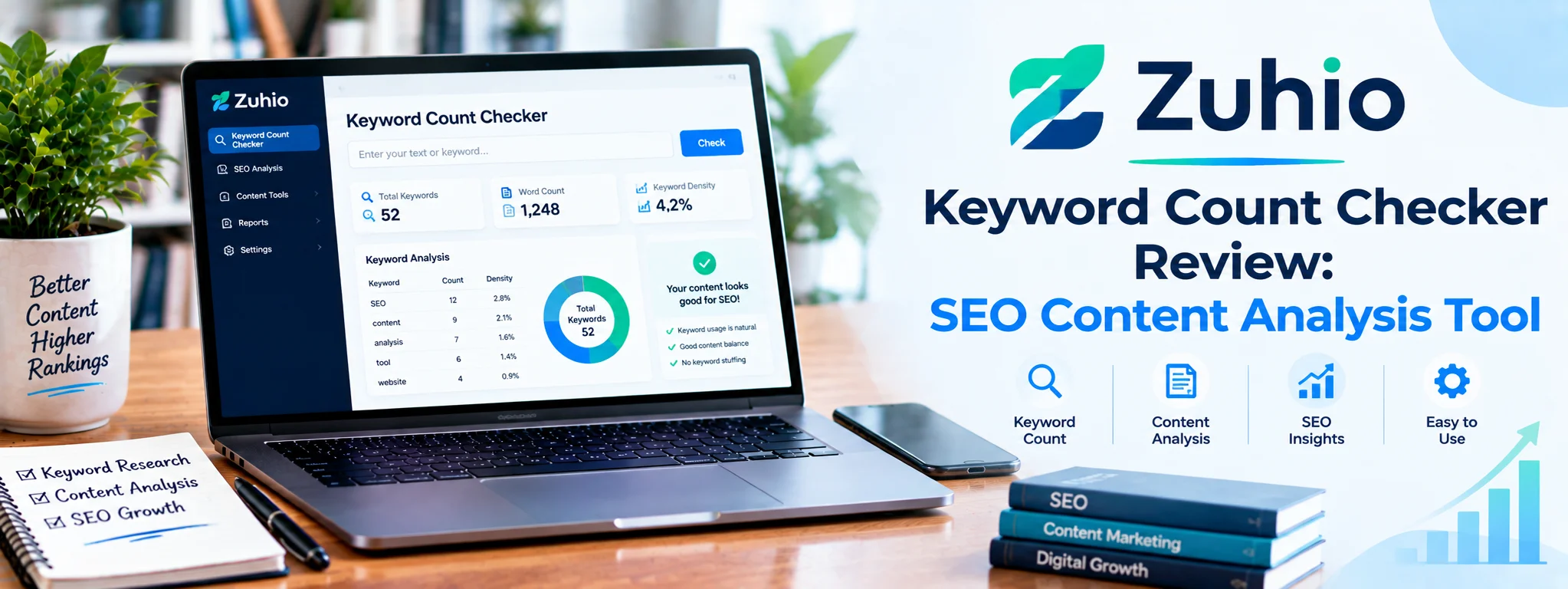
The Zuhio Keyword Count Checker topic is useful for writers, bloggers, marketers, and website owners who want a quick way to examine keyword usage in written content. Keyword counting can reveal whether an important phrase appears often enough, whether related terms are being used naturally, and whether a page may need further editing. Instead of relying entirely on guesswork, a keyword analysis tool can provide measurable information about the text before publication.
For modern SEO, however, counting a phrase is only one part of content analysis. Search engines consider context, topic coverage, relevance, readability, and user intent. A useful checker should therefore be treated as an editing aid rather than a complete SEO solution.
Understanding the Zuhio Keyword Count Checker
A keyword count checker is designed to identify how frequently specific words or phrases occur within a piece of text. A tool such as Ohio can be useful when reviewing an article before it goes live, particularly when the writer wants to confirm that a target term has not been forgotten or repeated excessively.
The basic process is straightforward. A user provides text, enters a keyword or examines the available word-count information, and reviews the resulting data. This can make content auditing faster than manually searching through a long article.
The practical value comes from using the results intelligently. A high keyword count does not automatically mean better optimization. Likewise, a low count does not necessarily indicate poor SEO if the page covers the subject thoroughly through related language.
Key Features to Look For in Keyword Analysis
The usefulness of a keyword checker depends on the information it provides and how easily that information can be interpreted.
Keyword Frequency
Keyword frequency is the most obvious measurement. It shows how many times a particular term appears in the content. This can help identify accidental underused or repetition.
For example, suppose an article targets “email marketing software.” If the phrase appears only once in a 1,500-word article, the writer may want to review whether the subject is clearly established. If it appears in nearly every paragraph, the text may feel unnatural.
Phrase and Word Analysis
Single-word counts can sometimes be misleading. A phrase-level analysis is more useful because SEO targets are often multi-word queries. Checking both individual terms and complete phrases can provide a broader picture of how the article is written.
Content Editing Support
Keyword data can also support editing decisions. Writers can locate repeated terms, replace unnecessary repetitions with natural variations, and improve transitions without changing the main subject of the page.
Zuhio Keyword Count Checker Review: SEO Content Analysis Tool in Practice
The real usefulness of a keyword checker becomes clearer during an actual content review.
Imagine an article targeting “home office design ideas.” After drafting the article, the writer checks the keyword usage and finds that the exact phrase appears eight times. Rather than immediately adding more occurrences, the writer reviews where those mentions appear.
If the phrase is already present in the introduction, a relevant heading, body text, and conclusion, adding additional repetitions may provide little value. The writer could instead strengthen related concepts such as workspace organization, lighting, desk placement, storage, ergonomics, and productivity.
This approach keeps the content focused on the reader while allowing keyword analysis to serve as a quality-control step.
Five Practical Ways to Use a Keyword Checker
- Check the primary phrase: Confirm that the target keyword appears in important sections without forcing it into every paragraph.
- Identify repetition: Look for wording that appears unusually often and revise it when it makes the article sound mechanical.
- Review related terms: Use natural synonyms and closely connected concepts to create stronger topical coverage.
- Audit finished drafts: Run the text through a checker before publishing to catch overlooked keyword issues.
- Combine data with judgment: Treat keyword counts as guidance and prioritize readability, usefulness, and search intent.
Keyword Analysis Metrics at a Glance
| Metric | What It Can Tell You | Useful Application |
|---|---|---|
| Keyword count | Number of appearances | Check target-term usage |
| Phrase frequency | Repetition of a complete search phrase | Review natural placement |
| Word count | Overall content length | Assess article scope |
| Related terminology | Supporting vocabulary | Improve topical relevance |
| Repeated wording | Potentially excessive phrases | Make content more natural |
A keyword checker becomes more valuable when its results are considered alongside the structure and purpose of the article. The numbers can identify possible issues, but a human review is still needed to decide whether those issues actually matter.
Why Keyword Density Should Not Control the Article
Older SEO practices often focused heavily on keyword density. Modern content creation requires a broader perspective. Search engines are increasingly capable of understanding relationships between terms, subjects, entities, and search intent.
For example, a guide about running shoes does not need to repeat “running shoes” in every section to demonstrate relevance. Discussions about cushioning, heel support, outsold durability, fit, terrain, and foot movement naturally establish the topic.
This means a keyword count checker should not become a target-setting machine. If writers add phrases simply to reach an arbitrary number, the result can be repetitive and less enjoyable to read.
Strengths and Limitations of Keyword Counting
Keyword counting has a clear benefit: it provides objective information. A writer can quickly see whether a particular term appears throughout an article instead of relying on visual impressions.
Its limitation is equally important. Frequency does not measure factual accuracy, originality, usefulness, search intent, sentence quality, or whether the reader’s question has actually been answered.
For that reason, keyword analysis works best as one stage in a larger content workflow. Topic research, outlining, drafting, editing, internal linking, and final proofreading should remain part of the process.
How to Use the Tool Responsibly
Start by identifying the primary search term and the main questions the article needs to answer. After writing the draft, check the keyword frequency and examine where the phrase occurs.
Next, read the article without focusing on the numbers. Ask whether the information flows naturally and whether each section contributes something useful. If a keyword appears repeatedly in places where it does not belong, edit those sentences.
Finally, review related terminology. Natural semantic language can make an article more comprehensive without relying on repeated exact-match phrases.
Final Thoughts
A ZOhio Keyword Count Checker Review: SEO Content Analysis Tool perspective shows why simple keyword analysis can still have a practical role in content production. Counting phrases helps writers spot missing terms, excessive repetition, and opportunities for cleaner optimization.
FAQs
1. Can a keyword checker improve SEO?
It can support SEO editing by showing keyword usage and repetition, but it cannot replace complete content or search-intent analysis.
2. How often should a keyword appear?
There is no universal ideal number. The keyword should appear naturally where it helps readers understand the topic.
3. Can keyword counting detect keyword stuffing?
It can highlight unusually frequent terms, which may help identify potential stuffing. A human review is still necessary to judge whether the repetition feels unnatural.
4. Should related keywords also be analyzed?
Yes. Related terms can help demonstrate topical coverage and make content more natural than relying heavily on one exact phrase.
5. Is keyword count enough for content optimization?
No. Content quality, relevance, structure, readability, intent, and useful information should also be evaluated before publication.
One Reply to “Zuhio Keyword Count Checker Review: SEO Content Analysis Tool”